
What Glass Coatings Actually Do (and What They Don’t)
There’s a lot of talk around glass coatings — easy clean, water repellent, stain resistant — but most of it doesn’t really explain what’s actually going on. That’s where the confusion comes from. Some people expect coatings to completely eliminate cleaning, while others think they don’t work at all. The reality sits somewhere in the middle, and unless you understand that properly, you won’t get the full benefit out of having one applied to your glass.
At its core, a glass coating is there to make the glass easier to clean and maintain, and more importantly, to protect it from long-term damage. Some coatings even have a self cleaning effect like Activ™ and Neat®Glass (both are permanent coatings) which use a photocatalytic process whereby organic dirt is broken down by daylight and is then washed away by rain. The key term is “self cleaning effect” and it does not mean you will never have to clean it. The simplest way to think about it is this: Glass coatings do not stop problems completely, they change how those problems develop over time. That’s the key distinction, and once that clicks, everything else starts to make sense.
Glass, despite how it looks, isn’t a perfectly smooth, inert surface. Most people assume it is, but under magnification it looks more like a mountain range, made up of microscopic peaks and valleys. That’s where minerals, contaminants, and everything else in the environment can latch on and begin building up. A nano coating — where “nano” simply refers to scale — is designed to interact with that surface at that level, modifying how it behaves rather than just sitting on top of it like a temporary layer.
Why Glass Needs Protection
Glass exists in a fairly hostile environment, especially in places like showers. It’s constantly exposed to water, dissolved minerals, heat, and cleaning chemicals, and every time water dries, it leaves something behind. Over time, those minerals don’t just sit on the surface — they can begin to bond with it and eventually chemically alter it.
That’s the point where cleaning stops being effective and glass restoration becomes necessary. It doesn’t happen overnight, but it is a gradual process that continues every time the glass is exposed to water and allowed to dry. A coating doesn’t make the glass immune to this process, but it does change how aggressively it happens and how far it can progress.
Instead of minerals bonding directly to the glass, they’re bonding to the coating. That difference might sound minor, but in practice it has a major impact on the long-term condition of the surface. The glass underneath is no longer taking the full force of that interaction, which makes it far easier to restore over time.
Different Types of Glass Coatings
Not all glass coatings are the same, and this is where a lot of confusion comes from. People often hear the word “coating” and assume they all perform in a similar way, but in reality, there are some clear differences in how they’re designed and how they behave over time.
At one end, you’ve got DIY or retail coatings. These are typically surface-based treatments that sit on top of the glass. They can create a short-term water-repellent effect, but they don’t have the same level of durability. With normal use and cleaning, they tend to wear off relatively quickly (in weeks), so while they can improve things temporarily, they’re not designed for long-term performance.
Then you’ve got manufacturer coatings (pyrolytic and sputtered). These are applied during the manufacturing process or shortly after. Options ShowerGuard™ or OptiShower™fall into this category. These coatings are permanent — but they’re still subject to real-world conditions. If they’re not maintained properly, they can degrade over time just like anything else.
Finally, you’ve got professional-grade nano coatings like NanoGlass Protection™that are applied after installation. These are designed to bond with the glass surface at a microscopic level and provide a more durable, long-term solution. They’re not just creating a temporary effect — they’re changing how the surface behaves, which is why they tend to offer more consistent performance when applied and maintained correctly.
How Coatings Change Water Behaviour
The easiest way to understand how a coating works is to look at how water behaves on the surface.
Hydrophilic Glass Surfaces
On untreated glass, the surface is ‘hydrophilic’. The water droplet spreads out and sits quite flat — the best way to picture it is like a ball that’s been cut in half. It doesn’t want to move, it tends to stay where it lands, and when it evaporates it leaves the minerals behind on the glass. There are hydrophilic coatings, and this is one of the actions that photocatalytic (self cleaning) coatings mentioned earlier use to work.
Hydrophobic Glass Surfaces
With a ‘hydrophobic’ coating’, that behaviour changes. The droplet becomes more rounded — not a perfect ball, but much closer to one. That change in shape is important, because it gives the droplet a much better ability to move across the surface. It can run down the face of the glass more easily, or be removed quickly, which means less water is left behind to dry and leave spotting.
That’s the level current real-world coating technology operates at. It improves the shape of the droplet and makes it easier for water to leave the surface, but it doesn’t make it perfect.
Super Hydrophobic Glass Surfaces
You’ll sometimes hear about ‘super hydrophobic’ surafces, where water forms into a near-perfect sphere and rolls off very easily. To achieve that, the surface needs to trap a layer of air underneath the droplet, which requires microscopic structures to be built into the surface of the glass.
That works well in controlled laboratory conditions, but those structures are extremely fragile. In real-world use — cleaning, wiping, normal contact — they break down very quickly, which means the performance doesn’t last. For that reason, superhydrophobic technology isn’t suitable for practical glass applications like showers.
So in real-world terms, hydrophobic is the balance between performance and durability. The droplet is more rounded, but not perfectly round, which means there are still limits. If a droplet is very small, it doesn’t have enough mass or shape for gravity to fully take effect, so it can still sit on the surface.
What This Means for Visibility Through Wet Glass.
A common question is whether a coating affects the clarity of the glass. The answer is simple — when the glass is dry, no. If you had two pieces of glass side by side, one protected and one not, even an expert wouldn’t be able to tell the difference just by looking at them. There’s no haze, no tint, and nothing visually obvious that gives it away. The coating is completely transparent. The only time you start to see a difference is when the glass is interacting with water.
How water behaves on the glass directly affects how clearly you can see through it. On hydrophilic surfaces, water spreads into a thin film, which creates a blurring effect because you’re effectively looking through a layer of water. On a windscreen, this leads to the familiar cycle of blur, wipe, see, blur, wipe, see, and in heavier rain there are situations where wipers can struggle to keep up.
Hydrophobic coatings change that behaviour. Instead of forming a film, water gathers into rounded droplets that are easier to move or remove. This improves clarity, because you’re no longer looking through a continuous layer of water. This effect is excellent for wet weather driving, or when enjoying the view through windows in your home.
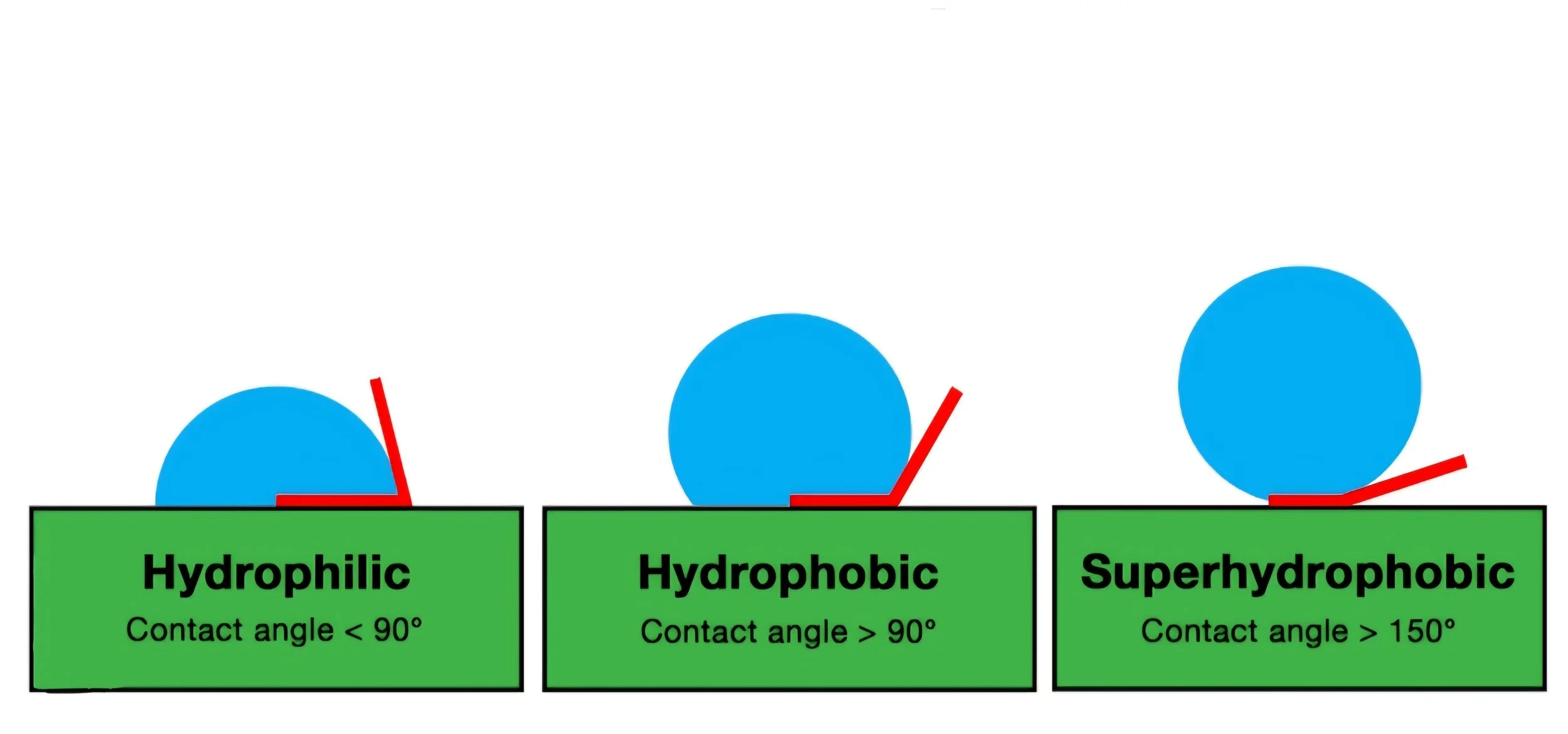
How water behaves on glass — from flat, slow-drying droplets to more rounded droplets that are easier to remove or roll off the surface by themselves. Low contact angle = flatter water droplets. High contact angle = ‘ball-like’ water droplets.
The Reality: No Coating Is Maintenance-Free
There’s no such thing as a maintenance-free coating. It doesn’t exist, and you can sanity-check that pretty quickly just by thinking about a car tyre that never wore out. It sounds good in theory, but it doesn’t line up with how materials behave in the real world.
Glass is no different. It’s constantly exposed to water, minerals, temperature changes, and daily use, so something is always happening to it whether you can see it or not. Even with a coating in place, if water is repeatedly left to dry on the surface, mineral build-up will still occur over time.
The difference is what those minerals are bonding to. On unprotected glass, they can bond directly to the surface and eventually start to chemically alter it, which is where permanent damage begins to form.
On coated glass, those same minerals are bonding to the coating instead of the glass itself. That doesn’t mean build-up can’t happen, but it does mean the long-term outcome is very different, because the surface underneath is still protected and far more recoverable.
Where Coatings Really Prove Their Value
Most coatings are marketed as an easy-clean solution, and while that’s true, it’s not where they really prove their value. The real benefit shows up over time, especially in situations where maintenance hasn’t been perfect.
On unprotected glass, neglect can lead to permanent damage. Minerals bond directly to the surface, react with it, and eventually create etching that can’t be fully reversed. At that point, you’re no longer cleaning the glass, you’re dealing with alteration of the surface itself.
On coated glass, even if it has been neglected, the situation is usually very different. The build-up is still there, but it’s sitting on the coating rather than the glass, which means it can be removed more effectively and with far less aggressive methods.
In many cases, the glass can be restored back to as-new condition in a fraction of the time. By comparison, unprotected glass that has reached the same level of neglect will often only come back to around 70–80% clarity, even with significantly more time and effort.
That difference in outcome is where coatings really show their value.
What Coatings Are Not
Glass coatings are not a get-out-of-jail-free solution for glass. They don’t eliminate the need for maintenance, and they don’t make the surface immune to its environment. There is no product that can completely stop water, minerals, and time from affecting glass.
Even if technology continues to improve, a coating that genuinely eliminated maintenance altogether would represent a fundamental shift in how materials behave in the real world. Realistically, something like that would be extremely complex, extremely expensive, and not practical for everyday use.
A coating is not there to make glass last forever without care — it’s there to reduce how quickly damage develops and to give you a much better outcome if things aren’t maintained perfectly.
The Bottom Line
A glass coating doesn’t stop water from touching the glass. It also doesn’t stop minerals from landing on the surface. What it does is change how those minerals interact with the surface, and that changes the long-term result.
It makes cleaning easier, reduces how aggressively staining develops, and most importantly, it acts as an insurance policy against permanent damage. In the real world, maintenance isn’t always perfect, and when that happens, the difference between coated and uncoated glass becomes very clear.
Copyright & Sharing Notice© 2026 Glass Genius Ltd. All rights reserved. You’re welcome to share a link to this article, but please do not copy, reproduce, or republish any part of it without written permission.
